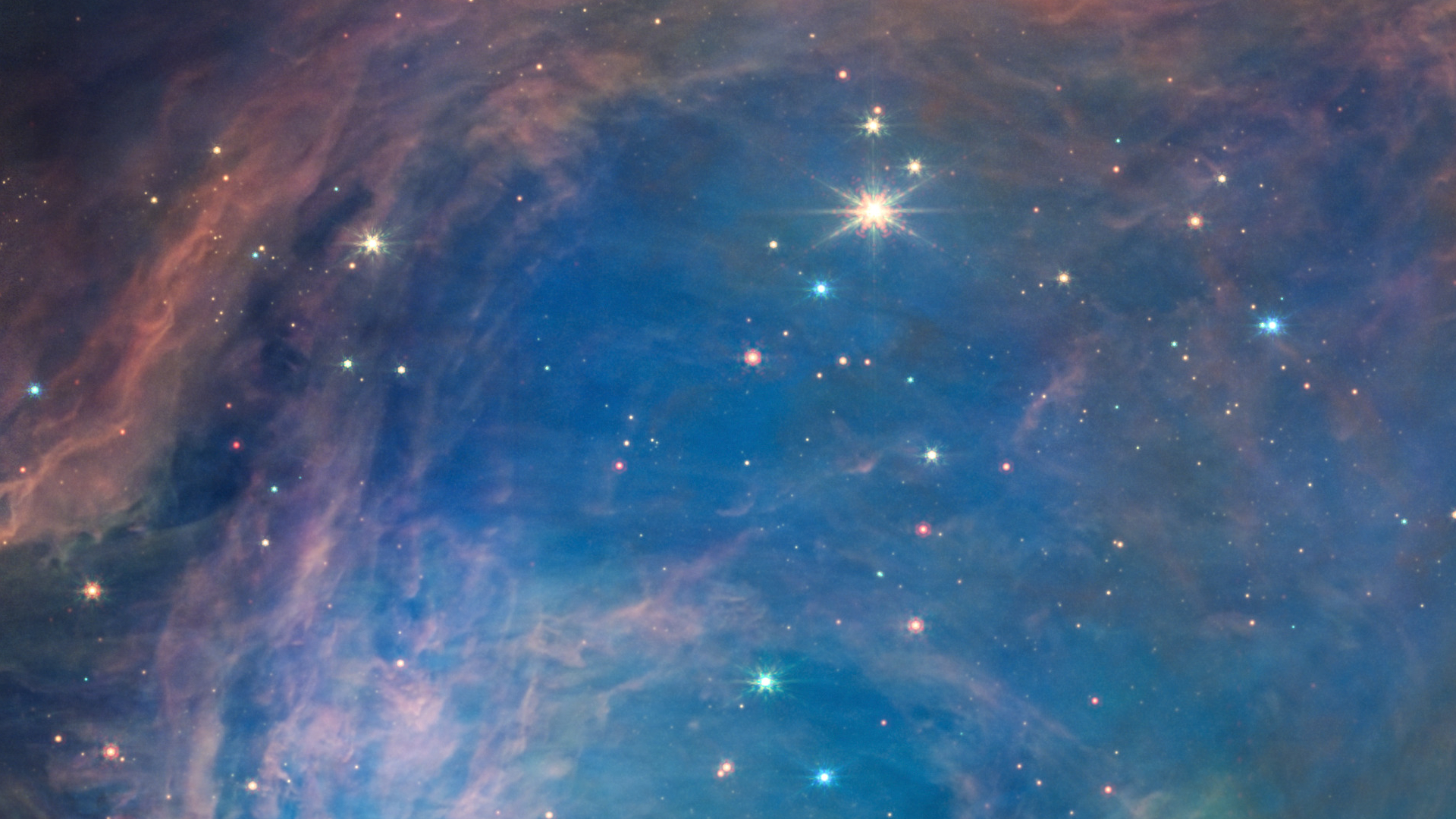
【Recap】The Universe and Life
Science points to several unwavering facts common to the cosmos and life.
The matter in the universe is finite, life consists of the minimal unit—the cell, and cells autonomously engage in cycles of death and regeneration.
Based on these certain facts, we observe that the Universe and Life share common structures: “Hierarchy” and “Circularity.”
The matter in the Universe is finite.
All observed matter and energy adhere to conservation laws and do not spontaneously increase without limit.
The minimal unit of life, which repeats death and regeneration, is the cell.
The fundamental functions of life—metabolism, proliferation, and environmental adaptation—are completed at the cellular level.
Within this unit, precise and elegant autonomous mechanisms are at work: ATP synthase rotates like a waterwheel to generate energy, and molecular motors walk like creatures on a rail to transport substances.
Both Life and the Universe possess a hierarchical structure.
The nested structure of Cell → Individual → Society → Celestial Body → Universe is unequivocally confirmed through observation.
【Fact】
And one more certainty regarding humans:
A person cannot survive on their own immediately after birth.
It is strictly and scientifically established that the functions necessary for survival are immature, making life maintenance impossible without the aid of others.
Up to this point, this is the solid foundation provided by science.
【The Universal View as Inference】
The content that follows is an “inference,” taking these scientific facts as its starting point.
It is positioned carefully as a stream of thought naturally derived from the shared structure of the Universe and Life, not as proven science.
- 【Inference】A Governing Entity Exists in the Universe
- 【Inference】The Owner of the Universe Does Not Offer Special Treatment to Life
- 【Inference】The Reason Why Humans Are Born with Conscience
- 【Inference】Rituals Are Not Required
- 【Inference】Management of “Rebirth Destination” Based on Core Value
- 【Inference】The Single Criterion Determining Core Value
- Summary So Far
- The Owner of the Universe: From Myth to the Age of Co-Creation
- The Reason the Concept of God Emerged
- Why the Concept of God Is Becoming Less Necessary Today
- 【Inference】Who, Then, is the “Owner” We Must Face Today?
- Summary: The Reason to Believe in the Owner of the Universe, Not God, Right Now
【Inference】A Governing Entity Exists in the Universe
Just as the individual manages the aggregate of cells,
the Universe, too, may possess a higher-level Governing Entity—an Owner of the Universe—to maintain its immense structure and inherent value.
This concept differs from a religious, personalized deity; it is a structural inference that the mechanism for maintaining the order of life operates naturally.
【Inference】The Owner of the Universe Does Not Offer Special Treatment to Life
Just as the human body does not give special treatment to every single cell,
the Owner of the Universe has no need to treat life individually.
It is likely that all life is evaluated impartially,
based solely on the value inscribed in the “Core” that each life possesses.
It is inferred that no one is treated specially for any reason.
All life is treated equally.
【Inference】The Reason Why Humans Are Born with Conscience
As mentioned earlier, a human cannot survive by their own power immediately after birth.
Yet, as they grow, they naturally develop a “Conscience”—a capacity for empathy, mutual aid, and building society.
Considering the origin of this “Conscience,”
the inference arises that
humans are born with a conscience because the Owner of the Universe preset that conscience before birth.
And, naturally,
There must be a profound meaning behind the Owner of the Universe setting this conscience.
(The nature of this meaning will be discussed later.)
【Inference】Rituals Are Not Required
Just as a person does not require prayer or rituals from their cells,
the Owner of the Universe has no reason to demand rituals from life.
Historical rituals are primarily cultural mechanisms established by human societies to maintain their communities,
and it is more natural to assume they are not based on universal principles.
Therefore,
The presence or absence of rituals does not affect happiness or rebirth.
【Inference】Management of “Rebirth Destination” Based on Core Value
Since life and matter are finite, circulation naturally occurs.
The following inference is derived from this:
Life possesses an informational center called the “Core.”
The next rebirth destination is determined by the value of the Core.
Inferior cores that failed regeneration are reborn as life with small influence (e.g., microbes).
Matured cores are reborn as humans or animals with greater influence.
The majority are reborn as cells, and only a small fraction become higher life.
This cycle model is not a religious doctrine but a rational model derived from the observed natural structure.
【Inference】The Single Criterion Determining Core Value
The value of the Core is inferred to be determined very simply:
For humans: Conscience
For other life: Instinct
All life is to bring about joy, which is the intention of the Owner of the Universe, by following these principles.
Special acts, such as rituals, do not factor into this evaluation.
Summary So Far
Science clearly demonstrates the shared properties of the Universe and Life—
finitude, nested structure, autonomy, and circulation.
Upon this foundation, the inference that the Owner of the Universe evaluates the core of life and reallocates its destination according to its value stands as a logical conclusion based on the structure of the natural world, rather than religious authority.
Furthermore, the conscience humans are born with is highly likely to be set with a specific intention by the Owner of the Universe.
What that intention is—the answer will become clear based on the content of the next page.
Life is treated equally within the cosmos,
and the maturation of its Core determines its next role within the vast hierarchy.
The Owner of the Universe: From Myth to the Age of Co-Creation
We live in an era where information is unprecedentedly connected, allowing us to share global knowledge.
From this new vantage point, we wish to meticulously reconsider the question that humanity has carried since ancient times: “Who is the Owner of the Universe?”
The Reason the Concept of God Emerged
The reasons humanity needed God since antiquity are thought to converge into the following two points, based on research in cultural anthropology, evolutionary psychology, and neuroscience:
(1) God as the Resolution of the Unreasonable
Ancient peoples routinely faced phenomena—natural disasters, epidemics, sudden death—whose causes they could not scientifically explain.
Neuroscience indicates that situations lacking a scientific explanation induce “intense anxiety” in the human brain.
To suppress this anxiety, humans tend to postulate an “Invisible Will.”
This is the archetype of God.
In the face of events too unreasonable to accept,
by concluding, “This is the will of God,”
they sought to segment the terror and sorrow and maintain mental peace.
(2) God to Preserve Social Order
In eras where complex mechanisms for ethics, negotiation, and mutual understanding were underdeveloped,
establishing a “Being that must never be disobeyed” preserved group order.
This is a phenomenon confirmed in religious sociology.
Communication was difficult between groups with different languages and cultures.
Invoking a “Presence that must never be touched” was a highly efficient method for avoiding conflict and uniting the community.
God was a “necessary apparatus” for synthesizing the inexplicable and aiding social control.
In essence, God was a concept that spontaneously arose as a human survival strategy.
Why the Concept of God Is Becoming Less Necessary Today
Modern humans live in an environment drastically different from that of humanity several thousand years ago.
With the Internet allowing instant sharing of knowledge globally, humanity is beginning to understand the following:
(1) Reduction of the Unknown by Science
Most natural disasters, diseases, aspects of life and death, and cosmic phenomena are now scientifically explainable.
As the scope of what can be explained expands, the motivation to require a “supernatural will” dissolves.
(2) Increased Mutual Understanding Through Information Sharing
Through the Internet and global exchange, humans can now understand the “inner workings of others” better than before.
The images of “savage foreign tribes” or “frightening unknown creatures” have been revealed to be misunderstandings created merely by a lack of information.
The majority of enmity, prejudice, and misunderstanding stems from a lack of information.
Now that this deficiency has drastically lessened,
the “role of mitigating conflict” once carried by God can be substituted by humanity’s own capacity for understanding.
If we engage in careful mutual understanding, most conflicts can be prevented.
Humanity can now share this fact on a global scale.
It is no longer an era where order can only be maintained by delegating inexplicable phenomena to “God.”
As knowledge is shared, misunderstandings are resolved, and mutual understanding becomes possible,
the necessity of relying on the concept of God is diminishing more than ever before.
【Inference】Who, Then, is the “Owner” We Must Face Today?
Let us now turn our attention to the real world.
The things we value in our daily lives—
houses, works of art, technology, land, minerals, energy resources—
things of value always have an “Owner.”
What about this Universe, which created us, holds the stars, and possesses immeasurable value?
Things of value have an Owner.
This is a fundamental reality of the world.
If so,
should not the Universe also have an Owner?
And it is more natural to assume that this entity is not the religious God upon whom humans projected their anxieties and hopes,
but a “Governing Entity” that is more realistic, logic-based,
and exists to maintain the structure and order of the cosmos.
Summary: The Reason to Believe in the Owner of the Universe, Not God, Right Now
God served a function in past eras by explaining the inexplicable and uniting society.
However, we now possess the means to share knowledge, deepen understanding,
and confront the unreasonable with science.
What is needed now is not a God born of human emotion,
but a stance of gazing upon the order and structure intrinsic to the reality of the Universe itself.
The perspective of postulating a Universal Owner is not religious faith,
but the modern extension of thought naturally derived from the Universe’s value, order, and structure.
We stand at the point of graduating from the Age of Mythology
and advancing toward the “Age of Co-Creation,” where we walk while understanding the Universe’s own mechanisms.
And to begin that journey,
reconsidering the “Owner of the Universe” instead of “God”
may be the most honest choice we can make for the future.